Astrogator's Logs

New Words, New Worlds
Rest
Artist, Heather Oliver             

Archive for the 'History' Category

Never Complain, Never Explain

Monday, December 27th, 2010

I’m the wall with the womanly swagger. – Judy Grahn, She Who

During Thanksgiving dinner at a dear friend’s house, another guest airily stated that climate change is a myth.  An environmental scientist and once a department chair in a well-known university, he now writes regularly for such venues as The Wall Street Journal using arguments along the lines of “There was radical climate change on earth way before humans came along.”  And like many self-satisfied self-promoters, he’s set on Transmit Only.

I was spoiling to kick him in a tender spot of his anatomy and it was obvious the other guests shared my wish.  But then the visit would have revolved around him.  So I looked straight at him and said, “If you really believe this, go discuss it with the people of Tuvalu, Kiribati and the Maldives, who are watching their land go under water as we speak.”  We all essentially ignored him for the rest of the visit. We had a terrific time.

I thought of this incident during the Stone Telling 2 roundtable.  Among other questions, Julia Rios, the discussion moderator, asked me, “In your own life you’ve chosen to engage in battles, and to speak out against things you perceive as unjust. How do you reconcile those choices with the costs attached to them, and is there ever a time when you choose not to engage?”

After I had answered Julia’s question, it lingered in my thoughts.  I often say (only half in jest) that humanity consists of several subspecies which happen to be interfertile.  We’re far more hardwired culturally than we’d like to think.  Progressive notions notwithstanding, facts almost never change the minds of adult humans unless something happens to affect them concretely in their health, status or wallet.  Battles against injustice, vested interests, willful ignorance, complacency, cruelty never end.  Before this relentless flood, people like me are Dutch boys with fingers in the dam.

Halfway through my fifth decade, I still haven’t learned to leave well enough alone.  By deed and by word, I’m still fighting on many fronts.  I’ll go to my grave angry, though the waters of Lethe will close over my small efforts as if I’d never been.  Yet after a lifetime of battles, I don’t have even a partial answer about how to engage effectively — especially since anger is still a heavily punished transgression for women.

Naturally, intelligent fighters adjust their strategy and tactics to fit circumstances.  Sometimes you have to be Odysseus, sometimes Alexander.  But I think there are two powerful weapons tikkun paladins need to use more often.  One is laughter.  Another is celebration.  The two share a crucial attribute: they’re not defensive; they assume legitimacy.

Accusing someone of humorlessness is a standard bludgeon used by knuckle-draggers of all persuasions.  “Can’t you take a joke?” is the constant taunt to outsiders grudgingly allowed into previously exclusionary clubs.  In all fairness, much humor relies on Us-versus-Them distinctions.  What’s amazing, though, is how fast bullies crawl off (bawling “You’re mean to me!”) when you turn humor against them.  There’s a reason why satirists and cartoonists are among the first to be arrested in dictatorships.  Of course, this tactic can get you badly hurt or killed.  Men in particular grow furious when women laugh at them.

I once was at another party where the guests were finance professionals.  The host held forth about the deep wisdom of polygamy: it’s nature’s way, our ape cousins have harems (obviously he knew zilch about either bonobos or chimpanzees) and as a dominant male himself, etc.  The other women guests were fuming, but too polite to contradict him.  Finally, I smiled at him sweetly and said, “I agree with you.”  Into the dead silence that ensued, I dropped, “Personally, I could handle at least three husbands.”  The women burst out laughing.  Several of the men spent the rest of the evening huddled in the kitchen, muttering darkly into their drinks.

The other way to short circuit reactionaries is to celebrate.  When some dim bulb bleats “Diversity brings down quality,” my reflex reaction is to verbally rip them to shreds.  However, a far more satisfying response is to issue invitations to a feast and call the endless rosters of Others who excel in a specific domain or task.  Women don’t write space operas?  Andre Norton, Ursula Le Guin, Alice Sheldon (aka James Tiptree Jr.), Joanna Russ, Joan Vinge, C. J. Cherryh, C. S. Friedman, Joan Slonczewski, Octavia Butler, Melissa Scott, Laura Mixon, Sydney van Scyoc, Kristin Landon, Elizabeth Bear, Gwyneth Jones, Liz Williams… without pausing to think and listing just those whose works I’ve read.

Celebration serves a dual purpose.  Not only does it lift the morale of those who stand arrayed against oblivious idiocy; it also prevents (ab)use of the “tone” argument.  Celebration recognizes past achievements and encourages forging ahead, rather than stooping to pick up every piece of broken furniture flung in our path.  Let god-wannabes stew in their own toxic wastes.  We have worlds to build and sustain.

Here’s the small personal roster of worlds I’m part of and want to celebrate as loudly as possible: my modest contribution to alternative splicing regulation and dementia research; Crossed Genres, Science in My Fiction, Stone Telling; my slowly emerging fictional universe, and the artists who depicted it so beautifully: Heather D. Oliver, Kathryn Bragg-Stella; and this site, now starting its fourth year, whose blog portion consistently hovers at high positions in Technorati rankings.

“Well we made a promise we swore we’d always remember,
No retreat, baby, no surrender.
Like soldiers in the winter’s night with a vow to defend,
No retreat, baby, no surrender.”

Bruce Springsteen, No Surrender

Images: 1st, Pict warrior Guinevere (Keira Knightley) in Antoine Fuqua’s King Arthur; 2nd, andártissa (resistance fighter) in WWII Greece (national historical archives); 3rd, Haldír of Lórien (Craig Parker) in Peter Jackson’s Lord of the Rings.

Yes, Virginia, Hellenes Have Christmas Traditions

Saturday, December 25th, 2010

Two decades ago, Ann Landers did a column about how various cultures celebrate Christmas.  Halfway down her list was this gem: “If you are Greek Orthodox, your sect celebrates Christmas on January 7.”  Several people wrote back that 1) the Orthodox church is not a sect – it is the original church from which the Catholic one split after the Schism of 1054 and 2) only the so-called Old Believers track Christmas by the Julian calendar.

I was reminded of this when I was leaving work two days ago, and a colleague asked, “Should I wish you Merry Christmas?  I heard you Greeks don’t celebrate it like we do.”  As readers of this blog know, I’m an atheist who misses many of my culture’s old customs, particularly those that thrum with pagan echoes. So I’m going to put my tour guide’s hat briefly on, and tell you what we Hellenes do around the time of the winter solstice.

The holiday lasts two weeks, from December 25 to January 6.  At the three punctuation points (Christmas, New Year’s, Epiphany) children make the rounds of the neighborhood houses, singing songs called kálanda.  These remain unchanged from the Byzantine era; they’re different for each of the three days and the kids sing them to the accompaniment of hand-held metal triangles – and more rarely, small bodhrán drums.  During these two weeks, people thought that mischievous spirits (kallikántzaroi) prowled the dark.  These obvious descendants of fauns and satyrs take a solstice break from trying to cut down the world tree that holds up the earth.  During the interruption the tree heals, leading to infinite annual repetitions.

People decorate their homes and start the feast preparations on Christmas Eve – and the original focus of the activities was not a pine or fir tree (a recent import from Northern Europe) but a small ship.  After all, we were seafarers even before Iáson sailed Arghó to the Sea of Azov in search of the Golden Fleece.  The main dishes vary regionally, but ham is not on the list.  Piglet, kid and lamb on the spit are, as is hen stuffed with chestnuts and raisins – turkey is too bland for Hellenic palates. The ubiquitous sweets are finger-sized melomakárona (honey macaroons) and kourabiédhes (butter almond cookies).

On December 31, families gather for the countdown, nibbling finger food – and at midnight, the ship horns can be heard from harbors and seashores, ushering in the new year.  Presents are put under the ship or tree when it is decorated but they get opened on January 1, either right after midnight strikes or in the morning.  The gifts are not brought by Santa Claus (Nicholas) who in the Hellenic hagiology is the patron saint of sailors.  Our giftbearer is Saint Basil, based on a real person: Vasílios the Great Hierarch, bishop of Caesarea in Cappadocia in the 4th century.  From a wealthy and influential family, he took time between arguments about dogma to succor the poor and needy, spending his entire inheritance on charity.

On the night of December 31, a candle is left burning next to a goblet of wine and a small plate that holds a golden coin (flourí).  On New Year’s Day the coin, presumably touched by Saint Vasílios, is baked into a rich bread pudding (vasilópita), which is later cut into named sections.  Whoever gets the coin will have an exceptionally good year.  On the same day, the youngest child of the family is the first to walk through the front door for good luck – often bearing a just-budding wild onion bulb, or cracking open a pomegranate… old, old symbols of wealth and fertility from the time when the virgins giving birth were called Isis, Astarte, Pótnia.

Epiphany, which rounds out the holiday, is also called The Lights.  On that day the priests go to each house, blessing it with a sprig of basil dipped in water.  Afterward, the priests from every coastal city, town or village throw a cross into the sea.  Young men dive to retrieve it, and whoever brings it back is blessed.  Just so did priests and priestesses of other religions also appease the oldest goddess of all – Tiamat, Thálassa – by offering her rings and other treasure instead of crosses.  The custom was retained by the Doges of Venice, the city state that owed its existence to the sea.

A few years ago Mr. Snacho and I found ourselves in Tarpon Springs, Florida, at the turn of the year.  The city was founded by sponge divers from the island of Kálymnos.  They still throw the cross into the sea.  Young men still compete for the honor of retrieving it.  And I, an exile by choice who’s often homesick for the place I left almost forty years ago, wept at the sight.

Images: 1st, Eiríni Vasileíou, cover for her The Christmas Ship; 2nd, kids singing kálanda; 3rd, photo by Mithymnaíos.

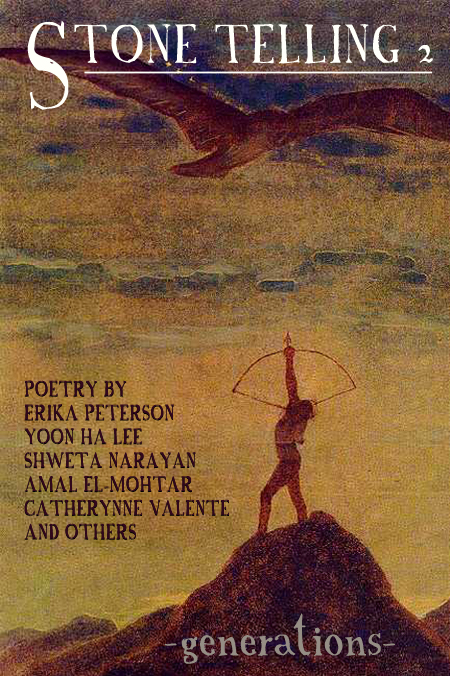
Stone Telling Issue 2: Generations

Monday, December 20th, 2010

Stone Telling Issue 2 went live this morning. As I said in an earlier entry, this magazine is the brain- and heart-child of Rose Lemberg who wished to elicit and showcase poetry that crosses boundaries. I’m triply represented in the latest issue by a poem, an essay and participation to the contributor round-table.

The focus of issue 2 is the chains that sustain us even as they bind us.  My dear friend Francesca Forrest has a deeply affecting poem in it, The Old Clothes Golem, amid a dozen equally stunning others.

I originally wrote my poem, Mid-Journey, in Greek. It is about feral loners like me who walk between worlds. The Greek text is there alongside my English translation, and there is also an mp3 file of me reciting it in the original.

My essay is about Sapfó, the Tenth Muse, the Blackbird of Lésvos. She has been different things to different people, so I thought I’d write about who she really was — and why she deserves her immortality.

The Volcano Always Wins

Tuesday, November 2nd, 2010

In Kazuo Ishiguro’s Remains of the Day the main character is James Stevens, a butler proud to serve his master, Lord Darlington – a rather dim aristocrat with political ambitions who becomes close to Mosley’s philo-Nazi Blackshirts. Stevens sacrifices all vestiges of self-expression, including the possibility of love, to become the perfect servant. His dignity and sense of office forbid him to question social and political rules and he remains loyal to the master-servant ideal even when its time is long past.

A week ago, Mas Penewu Surakso Hargo, known as Mbah (Grandfather) Maridjan, died on Mount Merapi in the Yogyakarta region of Java (founded as a sultanate in 1755). Maridjan, like his father before him, had been appointed guardian of Merapi by the sultan of Yogyakarta. He was in charge of ceremonies to appease the spirit of the mountain and he described his job as being “to stop the lava from flowing down”.

In 2006 and again in 2010, Maridjan refused to evacuate when Merapi erupted, calling himself and his fellow villagers the fortress whose function was to protect the sultan’s palace. Both times, others followed his example on the strength of his moral authority. He was found in a praying position, overwhelmed by pyroclastic flow from the mountain. Also killed were thirteen people who were in his home trying to persuade him to leave. The local populace is clamoring for a new guardian, and the sultan plans to appoint one soon.

Most people consider Stevens a deluded pathetic figure, despite his massive dignity and loyalty. Ditto for Harry Randall Truman, who elected to stay on Mt. St. Helens in 1980. In contrast, many consider Maridjan admirable, a laudable example of spirituality and adherence to principle, even though his actions led to preventable deaths.

Inevitably, there are more threads to this braid. Truman and Maridjan were in their mid-eighties; both voiced the sentiment that their time had come, and that such a death was preferable to dwindling away in increasing helplessness. The people of Yogyakarta are trying to preserve the pre-Islamic heritage of Indonesia against mounting pressure from the increasingly hardline official policies and the imams who enforce them. Additionally, many Merapi evacuees were left with nothing but the little they could carry, in a nation that has a rich legacy and tremendous recources – but one that also has had more than its share of natural and man-made disasters and whose political, ecological and economic status is wobbly.

Maridjan is admired as the keeper and transmitter of endangered cultural knowledge. I have already discussed this issue from the angles of deracination and art. The time has come to also point out the problems and dangers of tradition.

There’s no doubt that unique cultural customs keep the world multicolored and kaleidoscopic. Even though I’m an atheist and consider all organized religions unmitigated disasters for women, I’m still moved by the Easter ceremonies of the orthodox church. However, I’m not interested in their Christian-specific narrative. What moves me are the layers embedded in them: the laments of Mariam for her son are nearly identical to those of Aphrodite for Adonis, and they’re echoed in folk and literary poetry in which mothers lament dead sons (the most famous is Epitáfios by Yiánnis Rítsos, set to unforgettable music by Mikis Theodorákis). When I hear them, I hear all the echoes as well, see all the images superimposed like ghostly layers on a palimpsest. For me, that’s what lends them resonance and richness.

But there are times when I must part most decisively with tradition. There are plenty of traditions whose disappearance has made (or will make – many are still extant) the world a better place: from spreading bloody wedding sheets to foot binding to female genital mutilation; from forbidding women to sing lest they distract their husbands to knocking out teeth of new wives to show they will rely on their husbands’ prowess henceforth; from slavery and serfdom to polygyny and concubinage; from having unprotected sex with virgins to “cure” sexually transmitted diseases to “laying hands” on a child sinking into a diabetic coma.

Then there are the power-mongering charlatans who prey on fear and despair, particularly when hard times fall upon people: sickness, natural catastrophe, occupation, war. It’s true that Western medicine follows the heroic model – and as such it’s outstanding at treating acute illnesses but tends to over-specialize, sometimes at the expense of a holistic approach that treats the root cause rather than the symptoms. It’s equally true that modern technology has allowed ecological depradations at an enormous scale that threaten to become irreversible. Finally, it’s painfully true that deracination and colonialism often go hand in hand with modernization. Oppressed people revive or revert to traditions, often the last vestiges of suppressed cultural identity, as an act of resistance.

However, prayers don’t shrink a tumor nor frighten invaders away and the sun rises and sets whether beating hearts are offered to it or not. Too, if someone jumps from an airplane or a high ledge without a parachute, no amount of belief in divine favor will waft them away on a magic carpet or give them wings. Nor were traditional states pre-lapsarian paradises, as an objective reading of Tibetan, Aztec and Maori history will attest.

When we didn’t know the reasons behind phenomena, such customs were understandable if not necessarily palatable. Not any more, not with today’s knowledge and its global reach. The mindset that clings to the concept that incantations will stop a volcano is kin to the mindset the refuses to accept evolution as established fact. Standing in the path of a meteor is not the same as standing at Thermopylae, romantic notions of doomed last stands notwithstanding. The 300 Spartans who stood at Thermopylae had a concrete goal as well as a symbolic one: they stopped the Persian army long enough to give the rest of the Greek city-states time to strategize and organize. And the rarely-mentioned 1,000 Thespians who stood with them did so against their particular customs – for the sake of the new-fangled, larger concept of living in freedom.

In the end, the traditions that deserve to survive are those that are neutral or positive in terms of improving human life across the hierarchy of needs (and that includes taking care of our planet). Mbah Maridjan was the guardian of the mountain, which put him in the position of caretaker of his fellow villagers as well as of the putative Merapi spirit. If he saw his function as loyalty to an abstract principle of servitude rather than protecting his very real people, he was misguided at best – and his stance had far worse repercussions than those of Ishiguro’s Stevens, who only harmed himself and the woman who hoped to love him.

I once read an almost certainly apocryphal tale of a young woman who asked her rabbi, “Rebbe, is it ever acceptable to eat pork?” “Never!” said the rabbi. “Pig meat is always treff. Why do you ask?” “During last winter’s famine, I fed my young brothers sausages,” replied the girl. “It was either that or watch them starve.” “In that case, it was kosher,” decided the rabbi.

That’s the type of humane traditionalism I can live with. Tribalism was adaptive once, but has become a mixed blessing at best. Tradition encourages blind faith, satisfaction with rote answers and authority – and history demonstrates that humans don’t do well when they follow orders unquestioningly. As for the questing mindset ushered and encouraged by science, I will close with words I used elsewhere:

Science doesn’t strip away the grandeur of the universe; the intricate patterns only become lovelier as more keep appearing and coming into focus. Science leads to connections across scales, from universes to quarks. And we, with our ardent desire and ability to know ever more, are lucky enough to be at the nexus of all this richness.

Images: top, pyroclastic cloud from the Rinjani volcano, part of the Ring of Fire to which Merapi also belongs (photo by Oliver Spalt); middle, a Han Chinese woman’s “golden lotus”; bottom, wayang kulit — the Javanese shadow puppets, part of the Yogyakarta people’s heritage.

Songs of the Byzantine Border Guards

Wednesday, September 15th, 2010

Stone Telling magazine went live this morning. As I said in an earlier entry, it is the brain- and heart-child of Rose Lemberg who wished to elicit and showcase poetry that crosses boundaries. It contains an introduction by Rose, fourteen poems, three non-fiction articles and a round-table contributor interview.

Among the poems is my dear friend Calvin Johnson’s eloquent and thought-provoking Towards a Feminist Algebra. Among the articles is A (Mail)coat of Many Colors, my discussion of the songs of the Akrítai, the Byzantine border guards — poetry of a time, place and language that is virtually unknown in the Anglophone world.

Yet Hellenes still sing these songs… and they still reverberate in the popular imagination in subtle but powerful ways. As the accompanying image shows, Antoine Fuqua’s Sarmatian border guards in Roman England hearken back to the Akrítai of Byzantine Anatolia. Too, real amazons lived and fought in the lands of the Akrítai — a liminal zone where all kinds of boundaries were crossed and history survived as tales and songs.

The poems in Stone Telling open wondrous windows to the world. And if that is not the best purpose of poetry, what is?

Image: Left, the Byzantine warrior saint Merkourios, a Scythian by birth (fresco by Manuíl Pansélinos, Mt. Athos, 1360 AD); right, Ioan Gruffudd as a Sarmatian border guard in Antoine Fuqua’s King Arthur.

Ashes from Burning Libraries

Sunday, September 12th, 2010

…like amnesiacs
in a ward on fire, we must
find words
or burn.

Olga Broumas, Artemis

In the last few weeks, I’ve been watching the circus show of the (now postponed) Qu’ran burning with disbelief. Christians and Muslims have been playing variants of “If you don’t pay attention to my tantrums, I will shoot this dog” that was done far better by the National Lampoon. Government officials and media pundits are seriously suggesting that burning of a book that exists in millions of copies by a sad clown will touch off jihads. Yes, symbols are powerful — but fundamentalists will use any excuse for mayhem and bloodshed, whether they are white supremacists or the Taliban.

The real reason that many Muslims hate the US is because it has bombed two Muslim nations back into the Stone Age, is poised to do so to a third, and continues to pile up civilian casualties at a 100-fold ratio to US soldier deaths, while calling them “collateral damage”. Furthermore, to feed its petroleum addiction the US continues to staunchly support the primary source of militant Islamism: Saudi Arabia, whose deep pockets fund the madrassas that turn discontented, disillusioned Muslims into radical fundamentalists. However, it is equally true that imams and mullahs have issued death fatwas against books and their authors (Ayaan Hirsi Ali, Taslima Nasreen, Salman Rushdie, the Danish cartoonist who depicted Muhammad, to list just a few).

A favorite pastime of such militant religious thugs is destruction of knowledge. Islamists, like the self-labeled “man of God” Terry Jones and the medieval Catholics, burn books, burn schools, burn girls who try to attend school. They smash artworks – sculptures and paintings in the Kabul museum, the Bamiyan Buddha statues – following the example of the 9th-century Christian iconoclasts. People of this ilk burned the libraries of Alexandria. In those days of inscribing by hand, many works existed as single-number copies. As a result of this destruction, most ancient writers, scientists and philosophers are known to us only as names or sentence-long fragments.

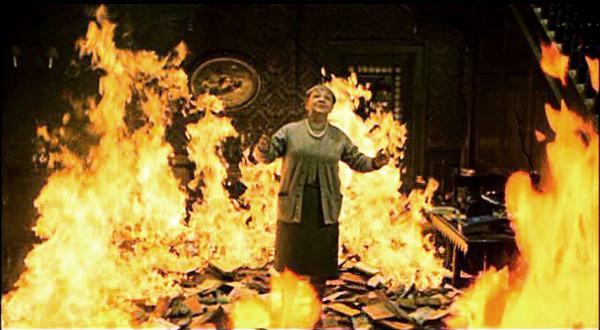
This loss, in all its enormity and poignancy, has been portrayed only three times in contemporary popular media. It is the center of Fahrenheit 451 and of Umberto Eco’s The Name of the Rose, a thinking person’s mystery-cum-novel of ideas. It is also depicted in the recent film Agora, a romanticized version of the life of the legendary mathematician and philosopher Hypatia.

Catholic apologists took Agora to task for inaccuracy and “inciting to hatred against Christians”. This advocacy is odd on its face, given that there was no “Catholic” church at the time, and the Alexandrian Patriarchate went into the Orthodox fold after the schism. Nevertheless, the circling of wagons is understandable, especially since Agora came out at the same time that Belgian authorities finally decided to investigate child abuse cases despite the Catholic church’s attempts to stonewall them. Their hodgepodge “arguments” (italicized) include:

Hypatia’s death was “purely” political; it had NOTHING to do with her gender, religion or occupation — which makes you wonder what their definition of political is.

Alexandrian mobs routinely rampaged and she just got caught in the crossfire. This is routinely followed by the directly contradictory she was killed as a reprisal for the execution of the monk Ammonius (who had stoned the prefect Orestes, as shown in the film). In other words, Hypatia’s murder was not random and had everything to do with what she was and represented.

The loss was small in any case, since Hypatia wasn’t THAT great a scientist/philosopher, she just rode on great men’s toga tails. This “reasoning” is very common (read Watson’s original depiction of Rosalind Franklin or Joanna Russ’ How to Suppress Women’s Writing). Conveniently, none of Hypatia’s own writings survived the various burnings. From my side, I could use this argument to point out that her loss far outweighed that of the monk.

The REAL Alexandria library had been burned earlier by Caesar’s troops. The Serapeum library, whose destruction is shown in Agora, was unimportant. This shows interesting value judgments. Furthermore, Theodoros Vrettos, in his book Alexandria, City of the Western Mind, presents convincing evidence that the fire in Caesar’s time happened at the harbor, nowhere near where the main library stood.

There are more of these, but you get the gist. Make no mistake, Agora has its share of stiffness and clunk. As far as I’m concerned, its major error is to show Hypatia young at the time of her death. In fact, she was somewhere between fifty and sixty when Christian fanatics flayed her alive. Although the death of someone beautiful and young may pluck harder at heartstrings, the choice served to render older women once again invisible. Also, Rachel Weisz, radiant though she may be, is single-note chirpy whether she’s teaching upperclass youths, figuring out the truth behind the arbitrary Ptolemaic epicycles, or proclaiming her adherence to philosophy. Helen Mirren, Charlotte Rampling or Lena Olin would have made far more nuanced, haunting Hypatias.

Conversely, I applaud Amenábar’s choice to show Hypatia focused on her work, and not willing to be deflected from it by pretty faces and the security they promise. The fact that all men in full possession of their faculties are shown in love with her is fine with me. It’s a welcome reversal of the usual setting; at least Hypatia deserves such adoration, unlike most male film “heroes”.

However, the film’s title names its true core. Agora means “marketplace”, but it had a more specific meaning in older Greek: it was the place where people met to discuss ideas. The film celebrates love of learning, the beautiful workings of the mind, and laments the fragility of reason at the face of close-minded fanaticism. Hypatia’s death is a coda – as she tells Orestes, the thugs have already won. It is the looting of the library that gives the film its emotional power. It’s the burning of all these irreplaceable scrolls that makes you weep.

In conscious homage to Carl Sagan’s Cosmos, Agora occasionally zooms out to view earth from space. As it does so, the screams and weapon clashes fade. And that may be the film’s second powerful point: in the vastness of the universe, we are nothing – except what we make of ourselves and our world. We can choose the way of the Taliban, the Teabaggers, the Hareddim, the Inquisitors. Or we can take the path of Hypatia. Between these two alternatives, there is no conciliation or compromise.

Images: top, Hypatia (Rachel Weisz) and Orestes (Oscar Isaac) watch the library burn in Agora; middle, book burnings past and present; bottom, a Hypatia figure in Fahrenheit 451.

Note: This article has been reprinted on Huffington Post.

No More Gritty Reboots! Part 2 — the Women

Friday, June 25th, 2010

by Alex Jacobs

This is the conclusion of Alex’s insightful rant about remakes of superhero films. In Part 2, he turns his jaundiced but discerning eye to the treatment of the other half of humanity in Hollywood reboots. I added a comment of my own at the end.

When I sent “No More Gritty Reboots,” it was intended as a stand-alone piece, but Athena did something rather irritating: she made me think. She pointed out that my examples only included male superheroes and asked if I’d care to see reboots of female superheroes.

I hadn’t realized I’d left such a gaping hole in my rant, but there it was. I had originally written it in a very stream-of-consciousness manner, which meant that female superheroes hadn’t even entered my train of thought. Why was that? It took me some time to figure it out, but the answers I came up with disturbed me a great deal.

I’ve no interest in seeing remakes of female superhero movies because the few that have been made have been so atrociously bad that I’d rather they scrap everything and start over completely. Most female superheroes work within groups (i.e. X-Men, Fantastic 4). While they may occasionally be given a worthwhile scene or two in films, such as Anna Paquin’s wonderful portrayal of Rogue’s fear at her growing mutant abilities in X-Men, the stories are still about the male characters. The only time a female hero has really been given equality within a group has been Elastigirl in The Incredibles.

To date, the overwhelming majority of female action heroes fall into two categories: ridiculously sexualized male fantasies (Catwoman) and male action heroes who happen to have breasts (Elektra). In very few instances are female heroes given the opportunity to explore what it means to be a female hero.

Catwoman had the potential to be a phenomenal character, as the comic books and the excellent animated series have shown.  Yet I have little confidence that Hollywood will move beyond the BDSM trappings and explore the reasons Selina Kyle has remained so compelling for over fifty years. While I would dearly love to be proven wrong, I suspect that Hollywood will see Catwoman only as a lithe young woman who wears a tight-fitting costume and carries a whip. While Tim Burton’s Batman Returns did much to explore the effects of trying to live a morally neutral life, even Burton failed to show Kyle as anything more than a freak avenger. Halle Berry did not improve matters and I see little purpose in rehashing that travesty.

I have even less confidence in Elektra. Her character was interesting in Daredevil because she was trying to balance her love for her family, a relationship, the risk of exposing herself emotionally, physically, and sexually, the danger of betrayal, and a drive for justice, all set against a world that systematically attempted to deny her agency in either a legal venue or as a vigilante. Is it any wonder she got a spin-off while Daredevil was quietly forgotten? However, Elektra completely ignored the character’s identity in order to prance her out in a ridiculously revealing costume to overly-sexualized, violent choreography (see this article on the impracticalities of female superhero costumes). Not even the fifteen year-old fanboy target audience was interested.

Jean Grey and Mystique do better in the first two X-Men movies, but the best female superhero in film remains Elastigirl from The Incredibles. As far as power and screen time goes, she is on par with the male characters. Her character integrates classically feminine roles (the caregiver) with classically masculine ones (the protector). Most importantly, she does not let herself be defined by either the superhero group or her family but chooses her own relation to both roles. To me, that is the ideal embodiment of feminism and gender equality: not a rejection of any given role because it is associated with one’s gender, but the power to choose one’s role. Our place in the world should not be defined by our birth, whether that means race, sexual orientation, class, or gender. In superhero movies, only Elastigirl truly gets it right.

Rather than remake these movies, I’d like to see completely different female superheroes get the full Hollywood treatment. I would hope that this would avoid female knock-offs (Superwoman, Batgirl, She-Hulk, etc). Rather, I’d love to see:

– Wonder Woman: Forget the powers. I’m interested in this movie because Wonder Woman isn’t just a powerhouse, like Superman, but a leader; not a soldier but a general. A Wonder Woman movie could not only serve as a positive feminist tale, but also expand our definition of heroism.

– Scarlet Witch: While lesser known than many other heroes, Scarlet Witch is one of the most fascinating. Her legacy is that of villainy but she often strives to be a hero. If we define feminism not as the championing of femininity against masculinity but as the attempt to rise above prescribed roles, I can think of no greater champion than Scarlet Witch. A Scarlet Witch movie would have more to say about individuality, family, and freedom than near anything else I can think of. That she’s a woman is part of her character, but not her defining trait.

– Stephanie Brown: If you’re not familiar with Stephanie Brown, please check Project Girl Wonder. Brown was the daughter of a super villain and, for a time, served as Robin, eventually dying in service in an incredibly disturbing and sexualized manner. The lack of acknowledgment of her death is a source of controversy within the comics community. I would love to see a Robin movie that featured Stephanie Brown rather than any of the rotating boys. Such a movie would include Batman but would focus on what it means to voluntarily work with such a disturbed individual for a choice you believe in. Whether Brown lives or dies in the film – and I believe the latter could be included in a respectful and appropriately literary manner – either conclusion would make it a tale well worth telling.

What are the chances of these movies being made? Pretty high, actually. Hollywood is motivated by money, and right now a super hero’s name in the title is the most overwhelming factor in whether a movie makes money. Will they be made well? That’s more debatable. Hollywood has shown that it can do superheroes well — even that it can do female superheroes well — but consistency is the big problem. Joss Whedon has shown he can deliver most consistently. He’s currently doing Captain America and The Avengers, which despite its historical lineup has no female heroes in the rumored cast, but maybe afterward?

I choose to hope.

Athena’s coda: Catwoman has been an incredible missed opportunity indeed, given the allure of Trickster figures. Additionally, she illustrates how differently women and men are judged for identical behavior. Both Catwoman and Batman are trauma-driven vigilantes; yet whereas he’s viewed as a hero and has the Establishment’s resources at his disposal, she’s often portrayed as a villain and operates without any external support. As for Elastigirl (girl?!), my take is less optimistic. Although she gets to exercise her powers, they are still strictly in service of her family — protecting her kids, cleaning up her husband’s messes — rather than the “larger” goals vouchsafed to male superheroes.

Superheroes who crack moulds: Xena Warrior Princess (Lucy Lawless); Catwoman (Eartha Kitt); Hiyao Miyazaki’s Mononoke Hime; Aeon and Sithandra of Aeon Flux (Charlize Theron, Sophie Okonedo).

Related posts:
Le Plus Ça Change…
The String Cuts Deeper than the Blade
Set Transporter Coordinates to… (the Star Trek reboot)
And Ain’t I a Human?

No More Gritty Reboots! Part 1 — the Men

Friday, June 18th, 2010

by Alex Jacobs

Today I have the pleasure of hosting the first part of an insightful rant by pen-friend Alex Jacobs. Alex graduated from Beloit College in 2005 with a degree in creative writing, literary studies, and rhetoric and discourse. In addition to amateur literary criticism, he currently teaches ballroom in Philadelphia, PA. Alex’s personal writings reside at Suburbaknght.

I’m sick of gritty reboots.

I was going to make a joke here about gritty reboots being the new black, but that doesn’t work. A gritty reboot just takes something and puts black on it. Don’t get me wrong, a gritty reboot can be fantastic (Batman Begins) but it can also be atrocious (Daredevil) or pointless (The Hulk, Star Trek).

I have to lay most of the problem at the feet of Batman Begins. Batman Begins was a fantastic movie, the reasons for which Hollywood seems to have missed entirely. Batman Begins took a superhero who’s always had a problem with camp and whose latest films had spiraled into self-parody and got rid of all the extraneous bullshit. Instead of ridiculous bat-themed gadgets we had tools that were actually useful and based on real technology. Instead of Gotham as a bright neon Blade Runner knock-off we got a shadow-shrouded city that was as much of a character as any of the actors. Instead of Three Stooges-esque comedy fight sequences we got commando-style combat encounters that truly felt threatening due to their violence.

These were great, but they weren’t what made Batman Begins a great movie. Batman Begins was great because it was populated by real characters. Bruce Wayne wasn’t interesting because he angsted but because his angst was a realistic and sympathetic reaction to what he’d gone through. Christopher Nolan and David Goyer wrote someone who was crazy enough that we all believed he could become Batman and but was still sympathetic enough that we wanted to observe the process. Batman Begins was about character.

Unfortunately, Hollywood didn’t pay attention to that. They saw sets with low illumination and characters with tragic pasts and said, “Aha! Keep everything dark! That’s what makes a great movie!”

No, no, no, no, no!

To paraphrase Aristotle, if characters in a drama behave in a believable manner and experience logical consequences because of that behavior, at the conclusion of the story the audience will experience “a useful fear.” It doesn’t matter if the circumstances aren’t realistic so long as the characters act in a believable fashion given the circumstances, because we will continue to identify with the characters and take something away from their experiences. That requires real characters.

Spiderman 3 was a fairly dark movie but the characters were morons. People don’t hate it because of the dance sequence and emo hair – they hate it because the dance sequence and emo hair are out of character, coming completely out of left field. Don’t believe me? Check out Doug “That Guy With the Glasses” Walker’s five-second movie. The first season of Heroes was amazing because it was filled with fascinating characters who behaved like real people despite the absurdity of dormant superhero genes, because we believed them when they reacted to such genes. The subsequent seasons fell apart because the story began to dominate the characters, and once that happens you realize how insipid the story really is.

I’m truly worried about Spiderman’s gritty reboot. I’m worried it’s going to be all grit and the producers are going to forget what made the first two movies so wonderful in the first place.

Then there’s the issue of rebooting origin stories. The origin story is the easiest to portray because it’s easier to sympathize with a normal person going through changes than a superhero dealing with being a superhero, but we need stories that go beyond puberty and mid-life crisis metaphors (X-Men and Iron Man respectively). We need stories about what it means to live in the new life you’ve created for yourself. Batman Begins was a great film but it was The Dark Knight that truly had something to say, and it was a message our society needs very badly.

Hollywood, don’t keep being gritty for the sake of being gritty and don’t keep rebooting because it’s easier to start over than to go forward. I want to see:

– A Superman movie that makes use of the “alien among us” concept to deal with 21st century loneliness.

– A Spiderman movie that uses choosing between two dreams as a theme and not a cheap way to raise the stakes.

– An X-Men movie that contrasts the team’s bemoaning their outsider status with the Brotherhood’s celebration of it (though one scene in X-2 did this very well).

I want stories that matter and characters I care about, not just endless dark-framed long shots followed by closeups of the heroes’ faces.

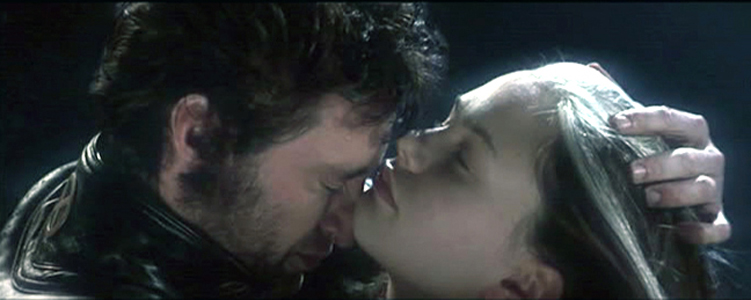
Images that linger, characters and connections that matter: Bruce brainstorms with Alfred in Batman Begins (Christian Bale, Michael Caine); Wolverine risks his life to heal Rogue in X-Men (Hugh Jackman, Anna Paquin); Theo and Marichka risk theirs to take Kee and her newborn daughter to safety in Children of Men (Clive Owen, Oanna Pellea, Claire-Hope Ashitey).

Related posts:
The String Cuts Deeper than the Blade
Set Transporter Coordinates to… (the Star Trek reboot)
Lab Rat Cinema: Monetizing the Reptile Brain

2012: The Dark Truth Finally Unveiled

Saturday, May 15th, 2010

by Larry Klaes, space enthusiast and science journalist

A slightly different version of this article appeared on The Tompkins Weekly on May 10, 2010.

Not since 2000 has an impending year so intrigued and concerned the general public like 2012. Many people have a vague idea that the world is heading towards some kind of doom because of a calendar created by an ancient and mysterious race. They see every new natural and artificial disaster as one more bit of proof that everything will come to a crashing end – on December 21, 2012 to be exact.

What are the real facts behind all the stories, hype, and concern about 2012? Ithaca’s Science Cabaret devoted its last program of the spring to this very year and topic. Titled “2012: Truths and Fictions”, the subject was tackled from two key angles by Ann Martin, a Ph.D astronomy candidate at Cornell and Wendy Bacon, an anthropologist at the University of Pennsylvania.

Bacon began with a very brief background on the Maya, the Mesoamerican culture which supposedly started all this fuss. Settled primarily in what is now southern Mexico and the bordering nations of Belize and Honduras, the Maya society (the letter n is added to the end of their name only when speaking about their language) existed from roughly 1500 BCE to 1500 CE when the Spanish conquistadors began settling their region. The Maya did not die out, however: Today between 4 and 9 million descendants of this once great society still live in the area, speaking twelve diverse languages and nestled among the rainforests and the remnants of the magnificent temples built by their ancestors.

Martin then took the stage to explain that a Cornell Web site titled “Ask an Astronomer” which started in 1997 and currently has over 800 answers to commonly asked questions about the heavens, began showing a noticeable increase in questions pertaining to 2012.

Martin examined some of the recent 2012 documentaries from The History Channel and the recent film with the year as its title. She noted that for the cable programs, sensationalism was prevalent. “Our days are numbered! Prepare for doomsday!” were some of the themes from the programs on The History Channel. As for what exactly is supposed to happen in December of 2012, Martin explained that we have been given three choices: A New Age style time of renewal, the actual end of the worlds, and a major astronomical event.

Bacon took the microphone from Martin to describe the Long Count calendar of the Maya which started our society’s focus on 2012. The Long Count began on August 11, 3114 BCE, a date chosen more out of numerical symmetry than anything else. The calendar’s choice of 2012 as its time to recycle is due to matching the number of days from its ancient origin. When Maya society began to collapse from the top down in our tenth century CE, the Long Count of measuring days went with it.  “2012 is based on something that hasn’t been used in a very long time,” stated Bacon.

Responding to the question of why our modern society has focused on a calendar system that has not been used by the people who originated it in centuries, Martin suggested that one reason is that 2012 will come about sooner than, say, the calendar of the Maya’s neighbors – the Aztecs – which will not see the end of its current cycle until 2027.

The Cornell astronomer then addressed the various celestial fictions that have arisen regarding 2012. As one example, some claim that Earth will align with the center of the Milky Way galaxy on December 21 of two years hence and this will somehow bring about a terrible disaster. Using a simple diagram, Martin showed that our world aligns with the center of our galaxy twice a year as Earth orbits the Sun, and has done so for roughly the last five billion years.

Martin dismissed claims that our globe will be destroyed when it plunges into the galactic core, which is over 26,000 light years away. She also explained that Earth and humanity will not be affected by plunging through the plane of the Milky Way or if the planets in our Solar System line up (which they will not do on any day in 2012). She noted further that Earth will not be struck by the mythical planet Nibiru, or be fried by the Sun if Earth’s magnetic field should suddenly reverse itself.

“The public should be excited about the Maya and astronomy,” said Martin. “But instead, people are freaking out about 2012 for false reasons. This is a real shame.” Martin and Bacon both expressed concern about how uncertain and frightened many people (in North America at least) are about the year 2012 due to these unsubstantiated rumors. The scientists foresee a backlash against science from these events, which Martin calls a “loss of cosmophiles” or people who might otherwise love learning about the Cosmos.

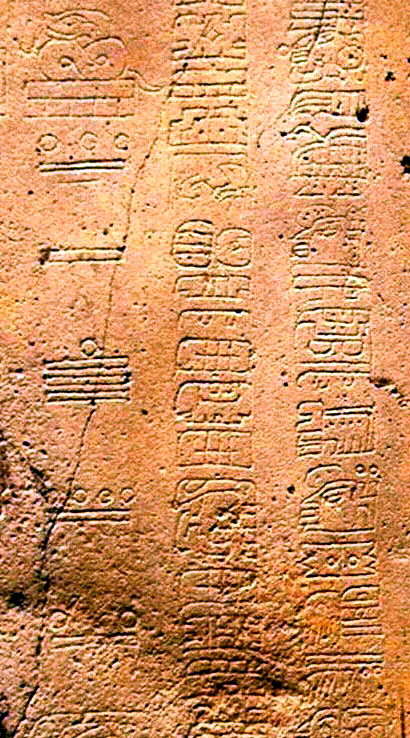
Images: Chichén Itzá temple/Maya glyph composite, Aaron Logan; glyphs from La Mojarra Stela 1, Veracruz, Mexico — the left column gives a Long Count date of 8.5.16.9.7, or June 23, 156 CE; Maya calendar cartoon, Dan Piraro.

Being Part of Everyone’s Furniture; Or: Appropriate Away!

Tuesday, March 16th, 2010

For I come from an ardent race that has subsisted on defiance and visions.

Two weeks ago, I was too tired to undertake the one-hour drive home after staying late in the lab.  I took refuge in a hotel with the proverbial 57 channels.  And so it came to pass that I finally saw 300, purporting to depict the life of Leonidhas and the Spartans’ stand at Thermopylae.  Except that the Spartans wore black naugahyde diapers, Xerxes was a slim version of Divine, his Immortals looked like orcs and Leonídhas showed his bravery by shoving an unarmed herald down a pit the size of an asteroid crater (in Sparta’s central square yet – bad for tots, to say nothing of fast traffic).

As I watched this dumb dull mess, it came home to me that my culture is deemed common property and used accordingly.  Yet few people really know anything about it beyond the cartoon version that passes for world history in most US schools.

As my readers know, I was born and raised in Hellás (as Hellenes, aka Greeks, call their country) and came to the US at 18.  Since my transplantation, I haven’t seen a single Anglosaxon film or TV show depicting Hellenic history or myth that was not cringe-worthy.  They’ve been so uniformly dismal that the cheerful hodgepodge of Xena was at the top of the pile (no exaggeration).  In 2005, literally everyone I spoke with asked variants of “Are all ‘you people’ like those in My Big Fat Greek Wedding?” and I had to restrain myself from wielding a baseball bat – or a spear.  There are three Hellene directors of international standing who explore the culture’s myth/history (Michális Kakoyánnis, Theódhoros Angelópoulos, Pantelís Voúlgharis) but their work appears only in art film archives.

I have also read vast numbers of historical and alternate history novels by Anglosaxon authors that take place in Hellas  – to name just a few, Mary Renault, Steven Pressfield, Barry Unsworth, Ellen Frye from the literary side; from SF/fantasy, Jacqueline Carey, Guy Gavriel Kay, Greg Benford, Jenny Blackford.  Many of these books are fine if judged solely on their literary merits, some are best passed over in silence. In most of them, the stray Hellenic phrases (even when uttered by natives) are at the level of tourist pidgin and the Hellene characters are Gunga Din sidekicks.  A few of the stories ring “real” enough that I can lower my shield and relax into them: Jim Brown’s Blood Dance, Roderick Beaton’s Ariathne’s Children, Paul Preuss’ Secret Passages.

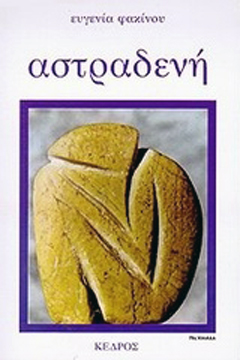
In stark contrast, Hellenes have no literary voice in the west.  Although ancient Hellenic literature used to be the province of any well-educated Western European man, the same cannot be said of contemporary Hellenic letters.  If asked to name recent Hellene writers, people may manage to dredge up Nikos Kazantzákis, and him only because of the popularity of the movie version of Zorba the Greek.  If they are intellectuals, they might be able to name the four world-famous poets: Kostantínos Kaváfis, Odysséus Elytis, Ghiórghos Seféris, Yiánnis Rítsos.  English-speaking readers can browse through translations of just about any national literature you can name. Yet translations of contemporary Hellenic prose are still non-existent.  Nobody knows that Hellas boasts perhaps the best magic realist in the world, Evghenía Fakínou; at least three living poets of giant stature: Victoría Theodhórou, Jénny Mastoráki, Kikí Dhimoulá; and a veritable galaxy of stellar novelists.

At the same time, Westerners are convinced that they “know” my tradition by hazy general familiarity, as I had the dubious privilege to discover.  Everyone mispronounces my name even after repeated corrections.  In my chosen research domain of alternative splicing, the established terminology of exons and introns betrays the namer’s ignorance of Hellenic: exons stay in, introns are spliced out to form the final RNA.  And in a concrete example from another realm, my submission to the Viable Paradise SF workshop contained scenes of contemporary young Hellene men teasing each other.  The participants who critiqued the work were American or Canadian; none had ever been to Hellás.  Yet they insisted that “only gay people talk like this.”  They took it for granted that they knew better than a native how Cretans behave and that their stereotyped assumptions trumped my first hand experience (so much for diversity and cosmopolitanism in SF).

There have been impassioned discussions in the speculative fiction community about whether authors can write with authenticity and moral authority about cultures that aren’t their own – travelogues aside, which invariably say more about the author than the place they are visiting, P. J. O’Rourke being a poster case.  This discussion cannot help but be complex because it’s overlaid with issues of race and colonization.  Taken to its extreme logical conclusion, the injunction of “Write (only) what you know” would put a fatal crimp on fiction.  On the other hand, the sudden emergence of Victorian Orientalism in steampunk is a serious added annoyance in an already self-consciously regressive subgenre.

Hellenes spent four hundred years under Ottoman occupation as second class citizens, subject to whim death and mob violence (flaying and impalement were among the common punishments), forbidden to learn to read and write their language, forced to supply their overlords with children who were turned into janissaries or odalisques.  The Hellenes – small from malnutrition and mostly olive-skinned and black-haired – were called “dirty darkies” when they first arrived in Western Europe and the US after the bruising civil war.  They were not people of color, but they weren’t considered Aryans either, as the Nazis decided during their occupation of Hellas: each German killed by the resistance merited the execution of at least ten Hellenes, or the slaughtering and razing of the entire nearest village.  The Hellas of today is a poor EU cousin currently undergoing a major economic crisis. Unlike AIG or Bank of America, it’s not “too big to fail” even though its debt ratios are similar to those of the US.

Yet the culture had enough élan and vigor to flower four times – Mycenaean, Classical, Alexandrian, Byzantine; the latter, totally ignored even in the anemic world history books, lasted a millennium and acted as a bridge and a buffer between East and West, between the Romans and the Renaissance.  Hellas gave the world much of its science, art, politics, philosophy (and before anyone starts emoting, I’m keenly aware of the equally decisive contributions of other cultures).  Its people kept their language, identity and spirit intact through all the violations and depradations.  Hellenes ace the verbal SAT with little effort, since everything in English longer than two syllables is mostly derived from our language.

So when all is taken into account, I think we are strong enough to survive even the crude cartoonish renditions of Hellas and Hellenes in the media.  I’m not sure if we’ll weather the imminent release of The Clash of the Titans remake, however.  Judging by its trailers, it will be yet another total chariot wreck.  And to Sam Worthington, a word of advice: that buzz cut reduces your hero status to zero. Hellenic heroes had long hair, from Ahilléas to Leonídhas to the untamed outlaws who wrested the country’s independence from the Turks. A shaved head was a sign of slavery. Long hair was a signal of freedom.

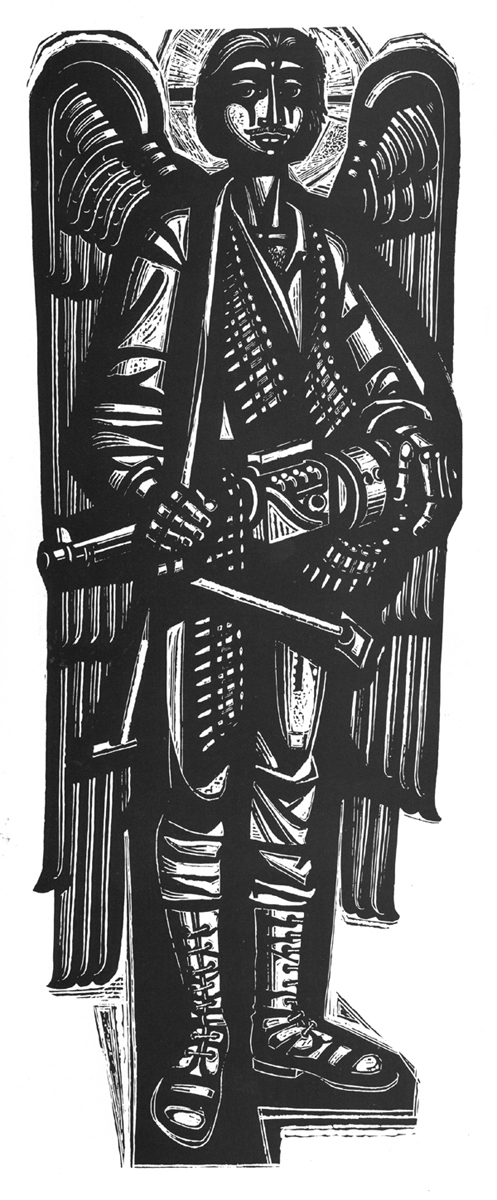
Images: The Angel with the Machine Gun, Tássos, woodcut (the figure is dressed like an andártis, a resistance fighter during WWII); Iríni Pappá (Klytemnístra) and Tatiána Papamóschou (Ifighéneia) in Kakoyánnis’ film version of Eurypídhes’ Ifighéneia; Astradhení (Star Binder), Evghenía Fakínou’s first novel; Thémis Bazáka (Eléni) in  Pantelís Voúlgharis’ Ta Pétrina Hrónia (The Stone Years); Athanássios Dhiákos, a freedom fighter captured and impaled by the Turks in 1821, age 33.

Note: Now also posted on HuffPo.

Related posts:
Iskander, Khan Tengri
The Hyacinth among the Roses: The Minoan Civilization
Jade Masks, Lead Balloons and Tin Ears
A (Mail)coat of Many Colors: The Songs of the Byzantine Border Guards
Evgenía Fakínou: The Unknown Archmage of Magic Realism
Herald, Poet, Auteur: Theódhoros Angelópoulos (1935-2012)

Camels, Gnats, and Shallow Graves

Saturday, February 6th, 2010

Nine years ago I met someone in a convention about science fiction and society.  Let’s call him Dr. B.  Because of our mutual interests, we moved in overlapping circles.  Dr. B. used to write  tie-ins to SF movies and is now a professional philosopher.  He’s white, middle class and lives in a Western democracy.  He is vocal about atheism, individual rights and censorship.

Recently, he stated that he cannot bring himself to sign a manifesto by Iranian women.   Why?  Because the manifesto calls for abolition of polygyny.  As Dr. B. loftily explained, that’s (horrors!) a slippery slope that could lead to state scrutiny of all polyamorous connections.  Never mind the fact that most polygynous marriages are contracted under coercion; never mind the fact that sharia law is state law in Iran and sharia law does not make a distinction between private and public, between religion and government.

In the meantime, Afghani girls have acid thrown on their faces because they are attending school.  Saudi girls are locked inside their burning school, because they might run out of the flames “not properly” veiled.  Somali girls are stoned to death because they were raped.  Sudanese girls have their genitals shredded.  Indian girls get set alight for having “inadequate” dowries.  And then we have stories like this, from yesterday’s news (composite from several sources):

Sixteen-year old Medine Memi was discovered bound and lifeless in sitting position in a hole dug beneath a chicken coop outside the family’s house in the town of Kahta in Southeastern Turkey, 40 days after she had disappeared. The hole had been cemented over.   According to a post-mortem examination the large amount of soil in her lungs and stomach showed that she had been buried while fully conscious and suffered a slow and agonizing death.

The execution was an honor killing carried out as a punishment for talking to boys.  Medine had repeatedly tried to report to police that she had been beaten by her father and grandfather days before she was killed. “She tried to take refuge at the police station three times, and she was sent home three times,” her mother, Immihan, said after the body was discovered in December.   Medine’s father is reported as saying at the time: “She has male friends. We are uneasy about that.”

In Turkey’s impoverished Kurdish region, the practice of honor killing has become a well-known ritual that is chilling in its precision: when a young woman is suspected of “dishonoring” the family by wearing tight clothes, having unauthorized contact with young men, or falling victim to rape, a family council is called, and a family member appointed as an executioner.  Afterwards, the family will try to pretend she never existed.

Official figures have indicated that more than 200 such killings take place each year, accounting for half of all murders in Turkey. Community workers say the figures are likely higher, as many go unreported.  After the 2005 reform, passed to help Turkey join the European Union, a new practice of forced suicide sprang up.  According to media reports, victims would be locked in their rooms for days with rat poison, a pistol or rope, and ordered to spare their families the legal retribution by killing themselves.

Dr. B. got huffy when I called his quibbles about the Iranian manifesto risk-free privileged nitpicking.  This, friends, is the epitome of swallowing camels and dissecting gnats.  The Greeks have a more vivid, if profane, saying: The world is burning, and some people are combing their pubic hair.  Perhaps Dr. B.’s olympian armchair philosophizing would benefit if he lived for a month or two in Afghanistan — in a burqa.

Images: Top, Medine Memi’s place of execution; bottom, Shamsia Husseini, who’s still going to school, even after she and her sister Atifa were almost killed by acid attacks.

“Against Stupidity the Gods Themselves Struggle in Vain.”

Tuesday, January 19th, 2010

Friedrich Schiller

Scott Brown; Cosmopolitan magazine, June 1982

Now the rest of the Cosmo centerfolds know they can be elected to the US Senate. If they’re reactionary rich white men, that is, who march to orders like Caligula’s Senate-nominated horse.

The Democrats should never have forgotten the tale of the scorpion and the frog. Appeasing the now-lunatic fringe Republican party is the equivalent of trying to befriend the creature from Alien.

Welcome to the world of The Handmaid’s Tale. When is the next starship for Tau Ceti??

“…and that Government of the People, by the People, for the People, Shall not Perish from the Earth.”

Monday, September 14th, 2009

— Abraham Lincoln, the ending of the Gettysburg address

Note: this article has now been reprinted at the Huffington Post, with the title America, Then and Now.

Three and a half decades ago, I chose to come to this country to attend Harvard, then MIT, a journey made possible by perfect test scores and full scholarships.  Though my father was a top-flight engineer, our income could never have afforded the astronomical (for Greeks) fees.  I was well aware that the US was far from perfect and saw more warts while I lived and traveled here – although, as I tell European friends who ask me how I endure it, I live in Cambridge, not the US.  Yet this nation was still a beacon for those of us who were hopeful romantics, who dreamed of achieving and contributing in an accepting meritocracy.

Apollo-1

When I first came, the prevailing attitude in the US was that of an engineer.  Failure was not an option.  Competence and problem solving were gods.  The infrastructure was superb, along with the civic attitudes and shared goals that go with such a context. The society was generous, curious, friendly, outward-looking.  I encountered other cultures mingling in the not-quite-melting pot, other ways of thinking that I would have never discovered in the homogeneous culture of my birth.

Then came the Republican interregnum, culminating in the eight nightmarish years of the Bush administration.  During those years, this country and its people turned into something sickeningly reminiscent of imperial Rome in its dotage.  Persons and institutions became incurious, willfully ignorant, sanctimonious, petulant, small-minded, small-hearted, irrational, inhumane.  They turned inward, stopped thinking of the future and the world – even as US corporations and armies laid waste to much of it – and concentrated exclusively on narrowly defined individual concerns with an attitude of “I got mine, Jack, and the devil take the rest”.  Efficiency and acountability gave way to ass-covering policies (from religiosity to convenient memory lapses) and “gotcha” economics; exploration yielded to forms in quintuplicate and small print.  Empathy, compassion, finesse, courtesy, eloquence, reasoning, learning became suspect.  Plans for great advances in knowledge and social justice dwindled to the tunnel vision of making enough money to escape to a Tyvek Macmansion with a 50-inch plasma TV in a gated community.

The facts around the Challenger explosion of January 1986 illustrate the beginning of the mindset that led to what we have become now.  The launch didn’t serve science but politics: it was meant to serve as a triumphal exclamation point to Reagan’s state of address; the civilian in the mission was deliberately chosen for mediocrity and in fact failed most of the NASA routine tests (the overriding criterion was that s/he should be a complacent, unquestioning Republican – a criterion later expanded for choices of key people, including the position of president); the administrators and contractors bullied the scientists into a risky launch, reversing the traditional decision policy; after the disaster, every involved party pointed at each other in a circle instead of taking responsibility or proposing useful solutions; and during the investigation, the opinions of qualified scientists were ignored – in fact, denigrated – in favor of an amorphous miasma of fake piety and indignation.  In the thirty years following, the Overton window steadily moved to the right and the bottom, resulting in today’s baboon shrieks from talk show hosts, financiers and politicians who use fear, hatred and ignorance as banners and prodding sticks.

Angry-mob

In short, a nation that once was at least trying to be progressive devolved into a horde of atomized, disenfranchised people who behave like spoiled children and allow their financial and political institutions to treat them like serfs – except that, individually and collectively, this country has an excess of “lawyers, guns and money”.  In a frightening parallel to the Weimar Republic of the thirties, people are encouraged to collude in their own enslavement and to vent unfocused anger on any convenient target – from the non-existent threat in Iraq to people who point out that anthropogenic global warming is with us or that healthcare in today’s US is an abject (though preventable) moral, financial, political and scientific failure.

Now, this nation has been granted another chance – perhaps the last chance to arrest the decline before it becomes irreversible.  Its people elected someone who embodies the signature outstanding qualities of this society: a mixed-race, multicultural, pragmatic meritocrat, a flexible and principled doer who, in political fact, is about as socialist as Eisenhower.  But one swallow doesn’t bring the spring.  And the tendency to put Others belatedly and grudgingly in positions of power during crises is a common ploy of those who want to maintain the status quo without consequences to themselves.  The unprecedented, unreasoning hatred and disrespect towards Obama is emblematic of the country trampling on its own best principles and representatives.

I chose this country as my home – and as a cultural half-breed I’m profoundly aware of its unique makeup and its still great potential.  As an immigrant, a citizen, a cosmopolitan, a scientist, a writer, a human being, I won’t give up the vision that brought me here and made me who I am. And I call upon all who dream and think likewise to join me:

Statue_of_Liberty

Let’s dig her out and rekindle her light!

Images: Top, Apollo 1 ready for launch. Center, a still from The Simpsons. Bottom, the famous closing image from Planet of the Apes (1968).

Is It Something in the Water? Or: Me Tarzan, You Ape

Sunday, August 9th, 2009

hemanSeveral decades ago, James Tiptree Jr. (Alice Sheldon) wrote a story in which aliens eyeing the lush terrestrial real estate introduce something in the water or the air that makes men kill women and girls systematically, rather than in the usual haphazard fashion.  Recent events have made me wonder if a milder version of Tiptree’s Screwfly Solution might be affecting the brains of self-defined “technoprogressive visionaries”… in which case we’re doomed if not to extinction, at minimum to a future that will make Saudi Arabia seem paradisiacal.
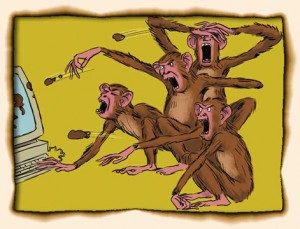
Exhibit 1: The upcoming Singularity Summit, exclusively a white boys’ treehouse, about which I wrote more extensively in Girl Cooties Menace the Singularity!

Exhibit 2:  The upcoming Mammoth Book of Mindblowing Science Fiction, modestly subtitled The 21 Finest Stories of Awesome Science Fiction.  I know two of the authors in it personally, and consider one a friend.  Nevertheless, all the stories are (rewind tape) by American or British white men.  When called on this, the editor of the collection explained that stories by women didn’t peg his mindblowing meter, because “women write more about people and their feelings”.  Oooh, these nasty girl cooties again!  Not to mention that if there are no people in a piece of writing, it’s called a manual.

Exhibit 3: The Lifeboat Foundation discussion list which, unfortunately for anthropologists and cartoonists, is not public.  In it, self-identified visionaries agree (in harmonious accord with fundamentalists) that the scarcity and silence of women in most mindblowing places are natural outcomes of such proven attributes as “alpha male rape genes” and women’s “wired for coyness” brains.  These people are not even remotely acquainted with biology, but feel completely entitled to pose as experts because they’ve written clunky science fiction and now collect speakers’ fees as futurists.  I discussed another aspect of this in On Being Bitten to Death by Ducks.

Intrinsically, these occurrences are as worthy of attention as the whining of a mosquito swarm.  However, one reason that Pod People come to mind is that the excuses have been identical in all three cases. The litany goes as follows:

1.    We can’t have population quota representation, because this is all about superior quality/qualifications that non-males and non-whites simply lack.
2.    Would you rather we included token women and minorities?
3.    My wife/girlfriend/mistress/concubine is a feminist and/or non-white and she agrees with me.
4.    Your humorless PC hysteria alienates those who would support you if only you were polite.

flingpoolmaoOf course, parity is not even remotely demanded — a mere one or two representatives often suffice as a sop (to such lows have we fallen). The bleatings about qualifications and tokenism are absurd, given the vast, stellar non-male non-white talent pool.  The excuses sound even lamer (if not malicious) when one scans the predictable, often mediocre, rolodex-friend picks actually made in cases 1 and 2 above… and in more instances than I care to recall at other times.

In the vast majority of cases, non-male non-whites are overqualified for whatever position or role they are chosen to fill.  The tokenism excuse has been obliterated countless times no matter how often the goalposts move, particularly when evaluations are made truly blind.  Whenever musicians audit behind screens, or names are removed from manuscripts and grant or college applications, the number of women and non-whites skyrockets.  As soon as Harvard adopted blind admissions in my junior year, the girl to boy ratio went from 1:7 to 1:3 in one year, just from the incoming class.  This was immediately followed by shrieks of rage by alumni, who whined that more girls would lower Harvard’s standards as well as its reputation.  These, by the way, were mostly legacy admissions that had scraped by on gentlemen’s Cs.

So what we have here are people so embedded in their privilege that pointing it out to them instantly strips away the progressive veneer and elicits poop-flinging that would make a baboon blush.  Women and other Others are still furniture – and though furniture is useful and can be decorative, it’s not supposed to move, dammit!  From there it’s a short jump to the transhumanist vision of a world where, as the Sad Children cartoon says, “being white and rich will be even more awesome” – and where all others will be either properly docile courtesy of happifying pills or outright extinct in favor of infinitely malleable cyborg dolls.

I think that true equality will come when non-white non-males can be as mediocre as white men.  And when that time comes, I guarantee you that the quality of mindblowing anthologies won’t budge.  In the meantime, we’ll have to make do with the overqualified Others that occasionally squeak past the endless hazing gauntlet – if the stuff in the water doesn’t get us first.

obama-sotomayor

Update: Graham Sleight reviewed Ashley’s collection in Strange Horizons… and his mind was decidedly underblown.  A fellow traveler of feminazis?  Objective pundits should investigate!

The Hyacinth among the Roses: The Minoan Civilization

Sunday, August 2nd, 2009

“But remember. Make an effort to remember. Or, failing that, invent.”  Monique Wittig, Les Guerillères

la-parisienneA story of mine, Dry Rivers, just appeared in Crossed Genres. It takes place in an alternate universe in which the Minoan civilization survives the Thera eruption. Coincidentally, I recently finished a book by Dr. Cathy Gere, Knossos and the Prophets of Modernism. The author discusses how the Minoan civilization served as a mirror that reflected the social biases of the era of its discovery – particularly of its idiosyncratic excavator, Arthur Evans.

During the Bronze Age, several major civilizations blossomed contemporaneously around the Eastern Mediterranean. Many are familiar to most Westerners, if only by name – the Egyptians, the Sumerians, the Babylonians, the Hittites. But one was sui generis: the Minoans. Despite their extraordinary achievements, we know a lot less about them than we know about their neighbors. Their alphabet, Linear A, remains undeciphered. Nor do we know what language they spoke, though a few Minoan words still adorn the Greek tongue, such as thálassa (sea), lavírinthos (labyrinth, house of the double axes), hyákinthos (hyacinth) and kypárissos (cypress).

I have always been haunted and beguiled by that lost civilization. Most of my fiction, whether of the past or the future, fantasy or science fiction, involves the Minoans. Not only are they part of my biological and cultural legacy; they were also unique. Minoan art is instantly recognizable. It is possible that the Minoan civilization might have changed the flow of history, had it not been literally snuffed out by the apocalyptic explosion of the Thera (Santorini) volcano. Such was the magnitude of the catastrophe that it became a potent, defining myth that echoes down the ages, from Plato’s Timaeus to Tolkien’s Númenor: the drowning of Atlantis.

How distinctive and advanced were the Minoans? Cathy Gere argues that they were not. She suggests that the attempt to portray Minoan Crete as a pacifist, matriarchal haven of high sophistication is not supported by the archaeological evidence, but is mostly a fantasy (largely created by Evans) to act as a paregoric to a world reeling from several major wars. Gere’s style is vivacious, articulate, elegant – and she knows her history. It is also true that Evans’ reconstructions of the Knossos palatial complex and its frescoes were heavy-handed and arbitrary. And in time-honored archeological fashion, he withheld evidence and suppressed careers that contradicted his theories.

If Gere’s book were your only source on the Minoans, you would come away well informed, highly entertained and with the impression that they were just a standard variant of the Bronze Age Levantine cultural recipe. And since Linear A has not been deciphered, the Minoans cannot tell their own story. However, extensive frescoes and other artifacts that have been gradually emerging from Akrotiri, the Theran equivalent of Pompei, support major portions of Evans’ theory. Because burial under volcanic ash kept everything intact, no question of false reconstruction intrudes. The frescoes didn’t adorn palaces, but residential houses. This fact alone says something about the Minoan culture. So does the finding that the houses were multi-storied and had hot and cold running water – amenities forgotten by their successors and the rest of Europe for almost four millennia.

saffron-gatherers-detail

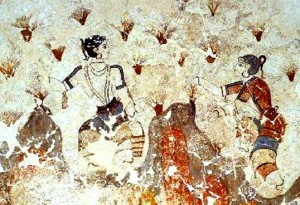
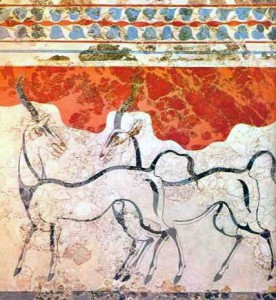
Even more indicative are the subjects of the frescoes: women gather saffron crocuses, boys box, crowds watch a regatta in a harbor, swallows intertwine over lilies, gazelles gambol. War is conspicuously absent – not a single battle scene, not one weapon, not even a chariot. Gods and kings, with their usual smitings, are also conspicuously absent. The focus is on nature and daily activities. This is true of all Minoan art, from frescoes to pots to seals. Too, there is a fluidity and exuberance that sets Minoan art apart from its Egyptian and Babylonian equivalents, which are oppressive with their will to power despite their beauty. And women are everywhere, always more prominent and detailed than the men, in stark contrast to their absence or subordinate status in the art of Crete’s contemporaneous neighbors.

In all other Bronze Age East Mediterranean cultures, the Great Goddess (Isis, Ishtar, Inanna) suffered dethronement at the hands of her Consort/Son. But in Crete she retained her primacy till the Mycenaeans arrived after the volcano eruption. This does not automatically imply that Minoans were matriarchal or that women enjoyed equal status in Crete. However, the scenes depicted in Minoan art suggest that women had significant rights and were active and valued participants in society. This is not surprising. Merchant and seafaring cultures are flexible and open to new ideas which they encounter willy-nilly, and Minoan Crete was both: the Egyptian, Babylonian and Hittite archives as well as the economic system deduced from the excavations indicate that the Minoan hegemony was light-handed, localized, sea-based and economic rather than military.

There is no doubt that Minoan Crete was not the utopian paradise that Evans envisioned. For one, if the Minoans had insisted on wearing only white helmets, they wouldn’t have lasted long enough to leave any legacy, wedged as they were between nations intent on empire. For another, the Minoans did have social classes: distinctions are clearly visible in the frescoes. However, it makes me happy and hopeful to think that there may have been at least one high civilization – the first one in Europe, in fact – that was not intent on conquest, enslavement and slaughter. That once perhaps there existed a people who were content to build and sail merchant ships, create ravishing art, sing harvest songs and love ballads… and gaze at the stars while sipping wine in the warm summer nights of the Aegean.

antelopes

Further reading:

Introduction to Akrotiri

Minoan portal

Frescoes:

Top, “La Parisienne”, Knossos, Crete; Middle, Saffron Gatherers (detail), Akrotiri, Thera; Bottom, Antelopes (oryx), Akrotiri

“Keeping an Open Mind Is a Virtue, but not so Open that Your Brains Fall Out.”

Friday, June 12th, 2009

— attributed to Jim Oberg, space journalist and historian

sokalAlan Sokal was a teaching assistant in my quantum mechanics (QM) course.  I still recall vividly the day he came with a graph showing the spike of the first-ever observed strange particle.  I remember, too, the playful twinkle in his eye. Thirteen years ago, Alan (at this point a physics professor at NYU) submitted a paper to the prominent cultural studies journal Social Text, titled “Transgressing the Boundaries: Towards a Transformative Hermeneutics of Quantum Gravity”.

On the day of its publication, Alan announced that the article was a hoax, “an experiment to see if a journal would publish an article liberally salted with nonsense if (a) it sounded good and (b) it flattered the editors’ ideological preconceptions.”  The editors of Social Text argued that Alan inadvertently expressed great truths in his article that even he wasn’t aware of – though they did take the precaution of having submissions peer-reviewed thereafter.

Slow forward thirteen years.  Fundamentalist branches of organized religions made a comeback, trying to obliterate the separation between church and state and to reclaim the domain of natural philosophy wrested away from them by science.  Some sprang to accommodate this “rapprochement” – most prominently Stephen Jay Gould with his theory of NOMA (non-overlapping magisteria), most loudly Matt Nisbet with his “framing” PR campaign.  We’re also awash in instant experts, courtesy of the Internet.  And all along, we have the very natural propensity to explain difficult concepts with analogies and metaphors.

As a result of this, religions from Christianity to Buddhism have been attempting to show that their tenets are compatible with concepts of reality developed through science.  Their vehicle of choice is – you guessed it! – QM.  QM enjoys particular favor for the same reasons that it appealed so greatly to the good folks of Social Text: it’s opaque, counter-intuitive, jargon-laden, safely remote from morality and has the cachet of vaguely-remembered great names associated with it (although Einstein opposed QM bitterly, because it couldn’t incorporate relativity and because he considered it ugly).  The results look exactly like Alan’s hoax paper – except that, unlike his, they are serious.

lars0896

For me this came recently to the fore when my blog-friend George Dvorsky posted a link to a video  which purports to show where science and Buddhism meet.  I watched it until I heard that “a particle is everywhere in the universe at all times”.  At that point I turned the video off and wondered aloud why I wasted even moments of my finite life on such arrant nonsense.

The snippets presented as QM facts in the video are at best extremely sloppy thinking, at worst an attempt to preempt, appropriate and mislead as insidious as Intelligent Design.  The Schrödinger equation, whose mangled presentation caused me to switch off the video, was the earliest mathematical description of a particle’s wave function. This formulation, although instrumental in the progress of QM, has problems with the time component and cannot integrate any aspect of relativity. The older formulations often lead to absurd results, such as zero denominators in equations — or infinitely spread particles. Since then, descriptions such as Feynman’s path integrals have solved some of these problems, although the final reconciliation may require the advent of a working grand unified theory.

Physicists and mathematicians are aware of these limitations when they use such constructs.  In contrast, when people who are not conversant with a scientific concept use it to lend credibility to shaky or shady conclusions, they become demagogues and/or charlatans.  And before anyone trots out the elitism hobby-horse, all I can say is, just have the next person you meet on the street repair your car or give you a haircut.  The same logic applies, and no amount of skimming Wikipedia entries will make up for in-depth knowledge and critical thinking.

Buddhism has become fashionable among people who wish to be considered spiritual but not “conventionally” religious, many of them self-proclaimed progressives – hence it’s de rigueur not to criticize it.  Some of its prestige comes from politics (primarily the Tibet/China situation, but only because it’s pertinent to US financial concerns), some from the intelligence and charisma of the current Dalai Lama, some from the simple fact that it appears exotic to Westerners when compared to the home-grown Abrahamic monotheisms.

tokonoma-3283I like the aesthetics of Zen Buddhism very much.  However, there is nothing to attract me in the religion’s misogyny (women cannot become Buddhas and must be reborn as men to attain Nirvana), its primitive cosmology of universe-toting turtles, its punitive stance that suffering is the result of bad past karma, its oppressive policies whenever it gained temporal power (including pre-Chinese Tibet, which was a far cry from Shangri-La) or the dog-like master/disciple formula that I dissected in my critique of that pinnacle of ersatz mythology, Star Wars.
Worse yet, what is the outcome of suppressing desire, Buddhism’s ultimate goal?  It’s the fate of the Miranda settlers in Serenity, the fate of any conscious being that gazes obsessively at its navel with the belief that reality is but an illusion.  If this is true, why explore or invent?  The Western religions have an awful lot to answer for.  But at least in their figures of defiance, from Prometheus to Lucifer, they incorporate a key element: striving for something larger than one’s puny self without letting go of one’s individuality.

I’m often told that science strips away comforting illusions or the mysteries that add beauty and meaning to life.  Yet which is a more potent (let alone true) image – stars as glittering nails inolympics crystal domes, or as incandescent engines that create life?  Science needs no pious platitudes or sloppy metaphors.  Science doesn’t strip away the grandeur of the universe; the intricate patterns only become lovelier as more keep appearing and coming into focus.  Science leads to connections across scales, from universes to quarks.  And we, with our ardent desire and ability to know ever more, are lucky enough to be at the nexus of all this richness.
On Being Bitten to Death by Ducks

Saturday, April 4th, 2009

Working feverishly on the bench, I’ve had little time to closely track the ongoing spat between Dawkins and Nisbet.  Others have dissected this conflict and its ramifications in great detail.  What I want to discuss is whether scientists can or should represent their fields to non-scientists.

There is more than a dollop of truth in the Hollywood cliché of the tongue-tied scientist.  Nevertheless, scientists can explain at least their own domain of expertise just fine, even become major popular voices (Sagan, Hawking, Gould — and, yes,  Dawkins; all white Anglo men, granted, but at least it means they have fewer gatekeepers questioning their legitimacy).  Most scientists don’t speak up because they’re clocking infernally long hours doing first-hand science and/or training successors, rather than trying to become middle(wo)men for their disciplines.

prometheusExperimental biologists, in particular, are faced with unique challenges: not only are they hobbled by ever-decreasing funds for basic research while expected to still deliver like before.  They are also beset by anti-evolutionists, the last niche that science deniers can occupy without being classed with geocentrists, flat-earthers and exorcists.  Additionally, they are faced with the complexity (both intrinsic and social) of the phenomenon they’re trying to understand, whose subtleties preclude catchy soundbites and get-famous-quick schemes.

Last but not least, biologists have to contend with self-anointed experts, from physicists to science fiction writers to software engineers to MBAs, who believe they know more about the field than its practitioners.  As a result, they have largely left the public face of their science to others, in part because its benefits — the quadrupling of the human lifespan from antibiotics and vaccines, to give just one example — are so obvious as to make advertisement seem embarrassing overkill.

As a working biologist, who must constantly “prove” the value of my work to credentialed peers as well as laypeople in order to keep doing basic research on dementia, I’m sick of accommodationists and appeasers.  Gould, despite his erudition and eloquence, did a huge amount of damage when he proposed his non-overlapping magisteria.  I’m tired of self-anointed flatulists — pardon me, futurists — who waft forth on biological topics they know little about, claiming that smatterings gleaned largely from the Internet make them understand the big picture (much sexier than those plodding, narrow-minded, boring experts!).  I’m sick and tired of being told that I should leave the defense and promulgation of scientific values to “communications experts” who use the platform for their own aggrandizement.

Nor are non-scientists served well by condescending pseudo-interpretations that treat them like ignorant, stupid children.  People need to view the issues in all their complexity, because complex problems require nuanced solutions, long-term effort and incorporation of new knowlege. Considering that the outcomes of such discussions have concrete repercussions on the long-term viability prospects of our species and our planet, I staunchly believe that accommodationism and silence on the part of scientists is little short of immoral.

Unlike astronomy and physics, biology has been reluctant to present simplified versions of itself.  Although ours is a relatively young science whose predictions are less derived from general principles, our direct and indirect impact exceeds that of all others.  Therefore, we must have articulate spokespeople, rather than delegate discussion of our work to journalists or politicians, even if they’re well-intentioned and well-informed.

Image: Prometheus, black-figure Spartan vase ~500 BCE.

Note: An earlier but more detailed exploration of this issue appears in my award-winning essay The Double Helix: Why Science Needs Science Fiction.

Update: As a prime example of the attitudes described in this article, view the speaker lineup of this year’s Singularity Summit.

Snachismo, or: What Do Women Want?

Thursday, February 12th, 2009

Between the approach of Valentine’s Day and recent discussions in a forum where a lot of stale sociobiological doctrines about women were put forward, I thought I’d put this up… planting a flag, as it were.

Even before hormones signaled my entry into the arena of sex, I had a sinking feeling whenever I contemplated relationships with the opposite gender. I had cause to be worried: I grew up in Greece during the sixties. At that time, the culture was as close as you could get to Islamic outside the Middle East. It approved of strong women – but its definition of female strength was endurance and constant giving. Both the Hellenic and Byzantine legacies of my people were solidly arrayed against uppity women, ready to strike, confine and prune.

hawkeye-coraSo there I was, bright, science-oriented, competitive, unfeminine, demanding equal treatment, expecting my future partners to be both lovers and friends… blessed, too (or should it be cursed?) with my father’s unstinting love, as well as his frank appetites and eye for beauty in everything. Glumly contemplating the thorny path before me, I frequently complained to him for bequeathing the wrong chromosome to the zygote that produced me. A pragmatic man with a strong streak of defiant aloneness, he was unrepentant. The fourth of five brothers with no sister, he was ecstatic that his single child was a daughter to whom he could give the name of the mother they lost too early in a terrible accident – even though he had to fight with the priests, because the name was pagan (there was no separation of church and state in Greece at that time).

I took an obvious path out of my difficulties. I left Greece the moment I could, an escape made possible by a Harvard scholarship. There were other reasons to leave, granted: Greece was a military dictatorship at the time, there was no scientific research going on there to speak of… but in the back of my mind, the question of partners lay like a sleeping dragon.

The first thing I did when I arrived in Cambridge and dropped my luggage on my dorm bed was to open a bank account. The second was to visit the student health services and ask for contraceptives. Those were the halcyon days after the Pill and before AIDS, when for one brief shining moment the act of love did not come festooned with punitive legal or medical strings. The dorms were co-educational, and my experiments in the domain of love were as eager, extensive and adventurous as they were in my courses.

About thirty years and fifty men later (counting short-term encounters), I think I’m finally ready to answer Freud’s burning question: What Do Women Want? I do not purport to answer on behalf of my entire gender. But I can unequivocally say what I want in my men and to put it in a soundbite, the answer is: Snachismo.

What, do you ask, is snachismo? It is a seamless fusion of snugglability and machismo. Those of you who read excerpts of my story Spider Silk saw snachismo embodied in the Koredháni men. For those who didn’t, I will briefly explain the concept.

To avoid confusion, I should point out right away that a snacho man is entirely distinct from a Byronic demon lover, a much more common type to whom many women are fatally attracted – sometimes literally, since many in this subgroup start as Heathcliffs and end up as wife beaters. All the dark brooders found in bodice rippers, including (alas!) Jane Eyre’s Mr. Rochester, are not snacho. Neither are alpha males or the so-called strong silent types.

So now that we know what is not snacho, let’s see if I can give you the gist of what is. A snacho man is physically, emotionally, intellectually adult. A snacho man, unlike an alpha male, gives his primary allegiance to his partner, not to other men. He actually likes women as people and is not afraid of them as partners or lovers – which means that, in contradistinction to the Byronic brooder, he has no need to dominate or play mindgames and is neither squeamish nor a prude in bed. Nor does he consider it unmanly to laugh, cry, be affectionate or express emotions beyond just anger (using words, not grunts or fists).

These are the primary irreducible attributes of snachismo. They may sound simple and easy but apparently are not, since few men achieve them. Several secondary attributes tend to arise from these. Given the pressure on both genders to conform to social stereotyping, a snacho man is likely to be a maverick and possess an unusual measure of both bravery and dash – an untamed wildcat, not a penned cattlebeast. He is also likely to have more than one active vocation or talent, and at least one in a domain considered not traditionally masculine. So a snacho man will have aspects of the bard, the storyteller, the contrary, the sorcerer, the shaman – roles that today’s men have largely abandoned in their apparent frenetic quest to become cubicle rats.

trevor-aeonA scholarly essay must, of course, give examples… and not surprisingly, I didn’t find obvious snacho candidates among most mainstream fiction. But I can name a few in science fiction: Dominic Harlech, aka Niki Falcon in Emma Bull’s Falcon; Radu Drac in Vonda McIntyre’s Aztecs and Superluminal; the Servitors in Sheri Tepper’s The Gate to Women’s Country – who turn out to be the real men, rather than the so-called Warriors. And off the top of my head, I can think of four in film: Trevor Goodchild (Marton Csokas) in the film version of Aeon Flux; Sam Gillen (Jean Claude van Damme, who would have thunk!) in Nowhere to Run; Rob Roy McGregor (Liam Neeson) in Rob Roy; and, of course, Hawkeye (Daniel Day-Lewis) in The Last of the Mohicans. In that film, what pinpoints him as the quintessence of snachismo is not his undemonstrative bravery, the many skills, the untameable beauty, the way he makes love (though they all help!). The unmistakable signal is when Cora takes out her musket during the ambush by the Iroquois – and instead of telling her that ladies don’t do that kind of thing, he hands her his gunpowder pouch.

So what about me? Well, thirteen years ago someone looked at me across a room. He had copper hair to his waist and the most intelligent eyes I have ever seen. A month after our meeting he showed up at my doorstep with his toothbrush and moved in. Suffice it to say that he fulfills all the attributes of snachismo, both primary and secondary… so there is hope after all.

Credit must go to Peter Cassidy for coining the term “snacho”. My thanks to Jester for pointing out that Liam Neeson as Rob Roy perfectly fit the snachismo model.

Photo Credits: Top, Cora (Madeleine Stowe) and Hawkeye (Daniel Day-Lewis) in The Last of the Mohicans. Bottom,  Aeon (Charlize Theron) and Trevor (Marton Csokas) in Aeon Flux.

And Ain’t I a Human?

Saturday, December 20th, 2008

The men are made tapu (sacred) while the women are left noa (common) for doing all those things at the back, like preparing and serving food. Wiremu Maihi Te Rangikaheke, Maori noble and recorder of Maori traditions.

I could work as much and eat as much as a man – when I could get it – and bear the lash as well! And ain’t I a woman? — Sojourner Truth, at the 1851 Women’s Convention, Akron, Ohio.

Fence

Curious about the scenery and forewarned about the schmaltz, I saw Luhrmann’s Australia. Like Dances with Wolves, Australia purports to express enlightened attitudes towards indigenous people. In both films, the good guys (and gals) go native; the directors condemn the casual, brutal racism of the eras they portray; and they show the indigenous people as possessing spiritual attributes vastly superior to those of their white supplanters.

In fact, these movies and their relatives shift the emphasis in “noble savage” from savage to noble but keep the condescension intact, leaving films such as The Chant of Jimmy Blacksmith, Black Robe, Smoke Signals, Rabbit-Proof Fence and Frozen River to do the real heavy lifting. However, Australia reminded me of an uncomfortable issue ignored or glossed over in both the real and virtual world: the treatment of native women by their own men.

In Australia, the grandfather of the young mixed-race protagonist looks after his grandson’s welfare by protecting him from enemies and dangers. The grandfather appears to possess magic powers that allow him to turn invisible, charm animals, travel faster on foot than whites do by car, unerringly find his way under any circumstances and in all terrains, show up whenever the boy truly needs him, and kill more efficiently with a spear than others can with a gun.

Yet the same powerful shaman lets his daughter die a gruesome, lingering death by drowning as she struggles to hide her child from the authorities that would take him to a mission school. She is a vessel for continuation, not of intrinsic worth in herself: Her father never taught his daughter to Sing or Dream, precious cultural knowledge that he’s eagerly imparting to his grandson to keep him grounded and connected to his people.

Hollywood films kill off mothers with distressing frequency, presumably so that the heroes won’t run the horrible danger of getting contaminated by excessive contact with women (aka girl cooties). But given the impact that films have on society, the positions in these films pose specific dangers to both native cultures and the relationships between them and those of the West with which they coexist. Letting the young protagonist’s mother die without a shrug — or any visible effect on him — allows film-makers and audience to ignore her cruelly inequitable treatment as the stuff of cultural fabric, unquestionable in its wisdom and perfection borne of pre-lapsarian, pre-contact mores and traditions.

Many argue that women’s position in indigenous cultures was enviable before the extreme dislocation brought on by genocide and subsequent disenfranchisement and marginalization. Yet the cultural norms prior to the arrival of colonialists with their guns and germs were a far cry from the idyll that revisionist Western directors portray. Even more tragically, the deracination brought on by the carnage of conquest gave the male survivors of the cultures a reason to grimly hang on to the least humane aspect of what defined them as men: brute dominance over those who could neither resist nor leave — namely, their women.

When the social pendulum swung from automatically denigrating native cultures to admiring them almost uncritically, the embracing was done primarily by men following the drumbeats of Robert Bly. And there is much to envy from the viewpoint of a cubicle drone, if he is male: Native men went on vision quests, hunting parties, raids. They had the privileges of carrying weapons, having initiation ceremonies, enjoying sweat lodges, speaking up in council, becoming war or peace chiefs.

While the men played, the women toiled at all the repetitious, semi-invisible tasks that keep the sun rising each morning: they raised the children, cared for the elderly, constructed the dwellings, collected the “gathering” portion of the victuals, prepared the food and clothing, cleaned up after everyone, alive or dead. They invariably ate last and least, and the most nutritious foods were forbidden to them: bananas in Polynesia, cocoa in Mesoamerica.

And if a hostile party raided, the women’s lack of weapons didn’t spare them. Women were booty — but unlike valuable livestock, they were often killed either outright or by extreme mistreatment during captivity, after the routine of being raped and witnessing the butchery of their children. In all fairness, that was also their fate in the supposedly chivalric West unless they were noble and/or rich enough to merit ransom.

The revisionist attitude, part guilt, part geopolitical convenience, part belated recognition, has resulted in “respecting traditions” by tolerating inhumanity against women in non-Western cultures — even allowing enforcement of separate, regressive family, education and healthcare laws in non-Western communities embedded within Western societies. People are called imperialists if they dare decry genital mutilation, stonings, forced marriages, honor killings. Had this viewpoint been adopted a century ago, footbinding and suttee would still be with us (though the latter continues indirectly as bride burnings).

If the West is responsible for the deracination and corruption of native cultures into caricatures of their former selves, then it must also take responsibility for the fossilized versions of the gender relations its interference allowed to persist. And if Western art wants to investigate the stories of indigenous women with verisimilitude and integrity, it owes them the respect of animating their narrative to a degree that the audience can appreciate their plight as well as their strength.

Women’s oppressed status in Western and native cultures is not going to be cured by the cinema. But one thing is certain. Filmmakers don’t do any favors to indigenous women or what is left of their cultures by depicting them either as disposable props or as immersed in unquestioning bovine pre-lapsarian bliss.

Frozen River

Credits: Top, Molly (Everlyn Sampi) and Daisy (Tianna Sansbury) in Phillip Noyce’s Rabbit Proof Fence. Bottom, Lila (Misty Upham) and Ray (Melissa Leo) in Courtney Hunt’s Frozen River.

Barack Hussein Obama, 44th U.S. President

Wednesday, November 5th, 2008

black-unicorn.jpg